
Videodrome and Seduction
How we love what kills us

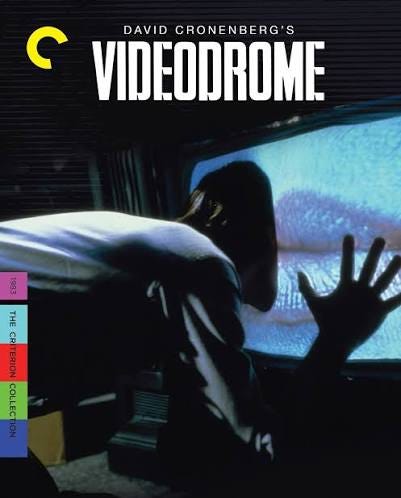
The highest praise given to Canadian filmmaker David Cronenberg generally goes to his 1986 film The Fly. To be sure, it is a magnificent achievement, deftly blending human tragedy, science fiction and body horror, boasting remarkable pre-CGI special effects, and containing three stellar acting performances from Geena Davis, Jeff Goldblum, and John Getz as the wonderfully skeezy Stathis Boranis. But the film is Cronenberg at his most mainstream, with the highest budget (relatively speaking) and the concept revising a previous film. But for the most Cronenbergian of his movies, for the quintessence of Cronenberg, you have to reach earlier into his career. Unfettered by Hollywood studios, his early movies are fever dreams of paranoia straight out of William S Burroughs, technological dystopias that rival those of JG Ballard, and a body horror that seems to be a preoccupation all of his own.
Thus, Scanners is a delight of inscrutable malevolent corporations striving to use those “telepathic curiosities” for their own ends and leaving a trail of destruction behind them. It contains perhaps the single most infamous shot of Cronenberg’s career - the exploding head, of course - but the film has several notable flaws, primarily the rather keystone cops plot, and a weak lead performance by Stephen Lack. (Michael Ironside, by contrast, is a delight). I love the retro-futurism of the movie, and how its sound design could have been done on a Commodore 64, but it’s not quite a fully realised movie.
The Dead Zone (1983) is an adaptation of a Stephen King novel, and as when John Carpenter adapted Christine in the same year, the highly visual sense of the author left the director with very few places to make his mark. (Whereas Stanley Kubrick had wisely gutted The Shining in 1980 in order to make his own film). And while Shivers (1975) and Rabid (1977) get many points for audacity and strength of vision, Cronenberg had yet to learn to shock with a fully realised intellectual purpose, while their low-budget effects now look very corny.
For what I feel is the defining statement of David Cronenberg, you have to look to Videodrome (1983). Here all his earlier obsessions meet: body horror, media, corrupt corporations, technology, celebrity, telepathy, viral diseases, and sadomasochism. Here, too, for the first time he succeeds on every level as a writer and director. Sure, the special effects are occasionally slightly clunky, but special effects man Rick Baker continues his extraordinary 1980s run of work. Yet it remains a staggering achievement, consistently producing images and sequences that amaze.
What most impresses about Videodrome is the integration of plot, theme, casting, and special effects. The action sees lead character Max Renn (a superb James Woods), owner of cable channel CIVIC-TV, encountering what he thinks is a pirate TV channel named Videodrome showing women being tortured and murdered. Disturbed but fascinated, he tries to track it down, but ventures down a rabbit hole into a world where reality and hallucination are indistinguishable, as Videodrome induces hallucinations that are not random distortions of reality but violent reprogramming of it. Similarly, the body horror is not merely a visual flourish. It externalises the central concern of Videodrome: the ability of media to colonise the mind and, eventually, the body itself. So Max Renn develops a vaginal chest cavity that accepts video tapes, as well as a gun that melds itself into his hand. Individual corruption is mirrored by corporate corruption, with Barry Convex slimily personifying their mental and physical degradations. His death is a literal putrefaction.
So it is with the theme of media, power and celebrity. Videodrome presents a world where the homeless sit watching TV in shelters, such is the hunger for media. (Remember going to internet cafes to get online? These look oddly familiar). This power gives media celebrities a priestly function, as shown by radio host Nikki Brand (played by Debbie Harry from Blondie - an inspired piece of casting), who dispenses psychological wellbeing from her booth. The power play of this is mirrored/amplified/redoubled by the sadomasochistic games Nikki plays with Max. “Cut me here,” she says, before burning her breast with a lit cigarette. “I’m going to try out for Videodrome,” she adds. “I was made for that channel.”

But as always Cronenberg undermines the boundaries. Who is the sadist here? It’s Nikki who has all the power. Max angrily tells her not to do it, but she ignores him. What therefore begins as a fantasy of male control is quickly revealed to be something else. Max spends much of the film believing himself to be a jaded consumer of images (“I’m looking for something that will break through. Something tough.”), yet he is repeatedly manipulated by forces he scarcely understands. (Videodrome was actually never transmitted, for example). Nikki, meanwhile, appears to embrace the very violence that captures Max. In Videodrome, power belongs to those who shape desire itself, and celebrity becomes one of the means by which that power is exercised. The viewer thinks he is choosing what to see; Cronenberg suggests he is being taught what to want.
The media theme is further explored through the character Brian O’Blivion, who will “refuse to be on television - unless I’m on television”. Based on media theorist Marshall McLuhan, whose ideas profoundly influenced Cronenberg, O’Blivion has become almost entirely media himself, existing solely through pre-recorded video messages. Long before social media profiles outlived their owners, Cronenberg imagined a man whose television appearances had effectively replaced his physical presence. O’Blivion’s famous claim that “the television screen is the retina of the mind’s eye” summarises the film’s argument. Television is not a window through which you view reality, but an organ through which reality is experienced. In Videodrome, control the image and you control the individual. The flesh, as Max Renn discovers to his cost, will follow.
Cronenberg reinforces this idea through numerous metafilmic devices. Many of the film’s key characters are first encountered through a television screen. The first character we see is CIVIC-TV colleague Bridey giving Max his “wake-up message”. Brian O’Blivion exists almost entirely as a televised image, while Nikki’s first appearance likewise comes through a broadcast. Max’s understanding of the world is increasingly mediated by screens, recordings and transmissions, as he is programmed first by Barry Convex then by Bianca O’Blivion and finally Nikki Brand. Most strikingly, the first thing the audience sees is the Videodrome logo itself. Before we meet a single character, we have already become viewers of the forbidden broadcast. The film thus implicates its audience in the very process it depicts. We are not standing outside Videodrome, safely observing its effects on others: we are consuming it alongside Max Renn. From the very beginning, Cronenberg is inviting us to question the images we are watching.
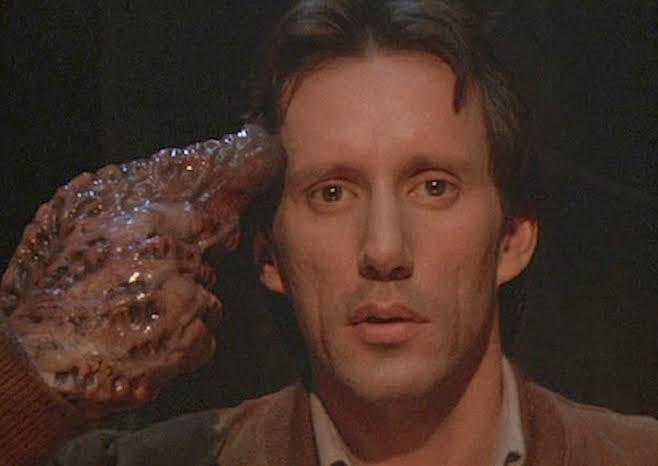
Yet Videodrome is not merely saying that media corrupts. All of the main characters embrace media to enact their own destruction. Max relentlessly pursues Videodrome, even when he knows it is ruining his life. (“I’m running like an express train. I don’t know how to stop,” he says to video pirate Harlan). Nikki Brand actively desires to go on Videodrome to satisfy her masochistic drives. Brian O’Blivion allows his physical self to be entirely supplanted by videotape. Harlan and Barry Convex want to use Max and Videodrome for ideological purposes, but are destroyed.
Many films have warned that technology may one day dominate humanity. Videodrome more originally proposes that we will invite it in ourselves. Max Renn is not conquered by force but by seduction. The signal succeeds because it offers him exactly what he wants. Cronenberg understood that the most effective forms of control are rarely imposed from without. They work through desire. We are vulnerable because we often crave the very things that programme us. If, as Oscar Wilde said in The Ballad of Reading Gaol, each man kills the thing he loves, in Videodrome Cronenberg suggests that we also love the thing that kills us.
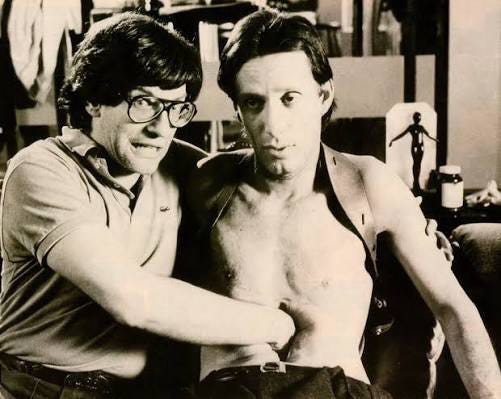
Even making the film demonstrated how behaviour can be mediated by media imagery. Cronenberg noted:
The crew was really freaked out by it; most of them people I’d worked with many times. We had some ladies come in and take their clothes off, then we’d chain them to the Videodrome wall and beat them — not for real. One or two of them quite loved it. Most of them were extras, and had never had this kind of attention. But the weirdness of it actually excited a couple of them. One kept reappearing on set, very made-up, very dressed, and just floated around. It was strange; she was someone who’d been strangled and beaten in the scene. So it was undeniably freaky being on that set. (Cronenberg on Cronenberg, pp97-98).
Even in the controlled environment of a film set, the dynamics that animate the movie bubble to the surface when given the opportunity. The borders between representation and participation that are central to Videodrome proved harder to maintain than anyone expected. This is deeply Cronenbergian – where is the boundary between life and art?
“It’s unlike you,” the character Masha says about Videodrome. “It has a philosophy.” This is exactly what separates Videodrome from almost every other film you see. This is why it endures. It goes beyond merely presenting themes into a genuine philosophy of media seduction. Cronenberg does not present television as a neutral technology, something you can use for good or ill, but as an extension of the body which can reshape reality itself.
What Videodrome ultimately proposes is even more disturbing. Its victims are not coerced but seduced. So now, nearly half a century later, in the age of smartphones, social media, and algorithmic feeds designed to satisfy our every appetite, its insights feel like prophecy. There are lots of films that warn us about the dangers of technology but few have shown how willingly we embrace it. If each man kills the thing he loves, Cronenberg’s darker insight is that we often love the thing that kills us. Videodrome thus remains his defining statement, fusing philosophy and horror into a single vision. It is disturbing not because its nightmares are impossible, but because they are now so familiar. Long live the new flesh.