
Capitalism's Moral Rot in Three New York Movies
Or how Stanley Kubrick Predicted Jeffrey Epstein

Modern cities are endless sites of reinvention, and movies about New York in particular demonstrate how the world is changing. Three movies set in the city from the 1970s to the 1990s exemplify how capitalism as a social relation has transformed. In The French Connection (1971), the drug trade is simply the dark mirror image of an economy still based on physical labour. In Wall Street (1987), director Oliver Stone presents two views of capitalism: the traditional, as voiced by brokerage boss (Hal Holbrook) as a source of finance for traditional industries, and the modern as exemplified by the Mephistophelean Gordon Gekko (Michael Douglas), which obeys only its own logic, has no conscience, and denies any social utility. “I create nothing;” Gekko says, “I own.” Finally, in Eyes Wide Shut (1999), wealth and power have become their own entirely self-serving systems, divorced from reality and enacting rituals of immunity. Each film reveals a stage in capital’s withdrawal from visibility and conscience, and how it has become a system running on belief and spectacle. Together, the three films demonstrate how capitalism has developed into a system no longer tethered to the mundanities of production or the inhibitions of ethics, and one now driven only by its own absurdist, viral logic.
Contact Crime
In The French Connection, director William Friedkin masterfully captures the gritty textures of the urban landscape: heroin deals and police surveillance alike are done in person, in real time; the knitted woollen gloves of the policeman Popeye Doyle (Gene Hackman) standing shivering in a doorway, the “grape drink” and toffee apple sold at the subway station, the burned-out empty lot, the early-morning bar where you can pass out without being asked to leave. New York in The French Connection is still a grimy industrial city. We can see this in the dockside scene where the car bearing the heroin is transferred by crane sling, with its litter-strewn piers, forklifts and longshoremen.
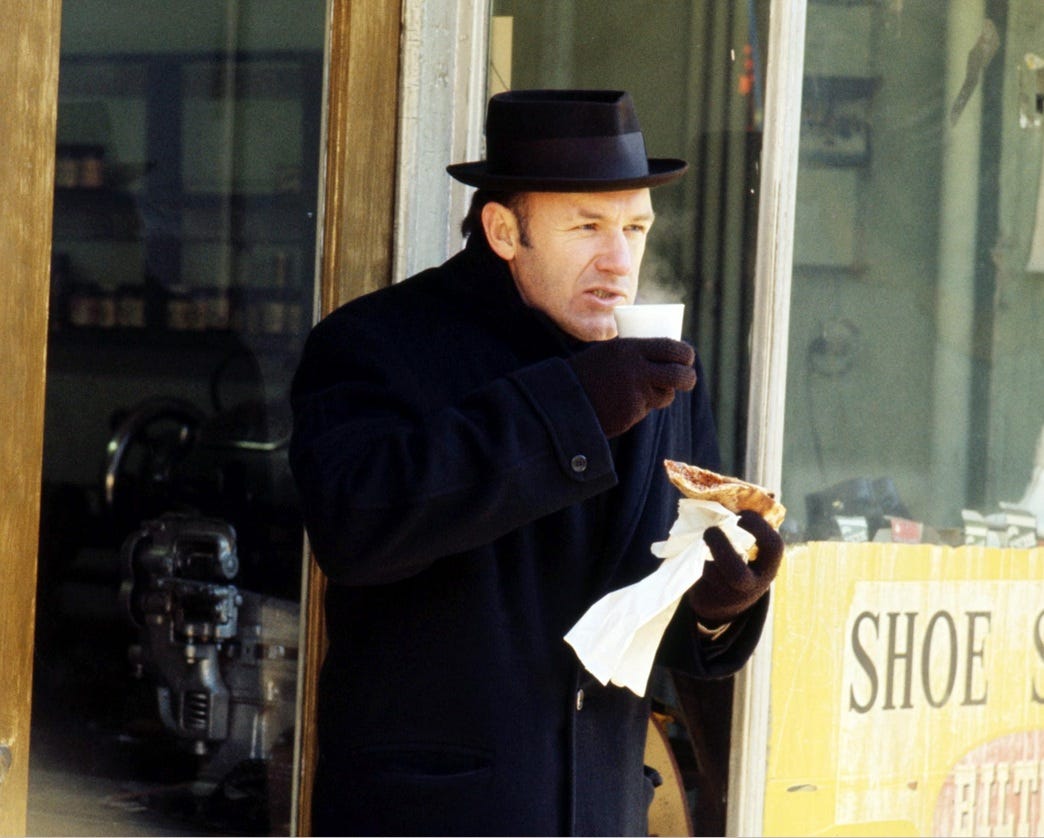
Everything is physical, visible, if not always understood. Sal Boca first attracts attention because he’s spending money “like the Russians are in town”. He and the other conspirators are tailed throughout the city from subway to Fifth Avenue, its traffic networks wide open. “I haven’t spent five minutes in New York City without the company of a gendarme,” Frog 1 (Charnier) complains to Sal. But he has no choice. Heroin is a physical commodity and must be exchanged in real time, for hard cash. Twice the policeman Cloudy Russo bumps into the conspirators. This is a city of chance, but also of physical contact. More than that – because it is a city of physical contact, it is a city of opportunity. The meat space is a meeting place.
In The French Connection, the urban architecture and moral architecture are equivalent. The teeming streets, the subway trains, the urban bars busy all day, the graffiti-covered alleyways: this is an economy that runs on sweat, toil, and low land-values. Friedkin’s handheld documentary realism (not one set was built for the film – it’s all filmed on location, as Friedkin boasts in his memoir The Friedkin Connection) makes commerce kinetic and contagious, while the famous car chase is a clear metaphor for Doyle’s lawless desperation. The police procedural here becomes a metaphor, even myth: the city as open circuitry, with corruption visible, persisting because it is structural, not individual.
Friedkin shows how capitalism means human contact and visibility. Just as factories required surveillance, Doyle and Russo strive to monitor the drugs trade in person, tailing the suspects and bugging their phone lines, while supervisors withhold trust (“You got more collars than any Narc in the bureau. What was it, over 100 last year? Terrific. But who? You stop and shake down a bellboy because he’s got three joints in his sock?” their boss says). They make headway through attrition, wearing the network down until the last handoff. The point is not their incompetence but economic friction: when goods still have weight and cash still has to move, power has fingerprints, and that makes it vulnerable. The very frictions that keep the city corrupt also keep it legible. In The French Connection, capital can still be followed through streets and doorways. In the worlds that follow, it will learn how not to leave a trace at all.
The Glass Menagerie
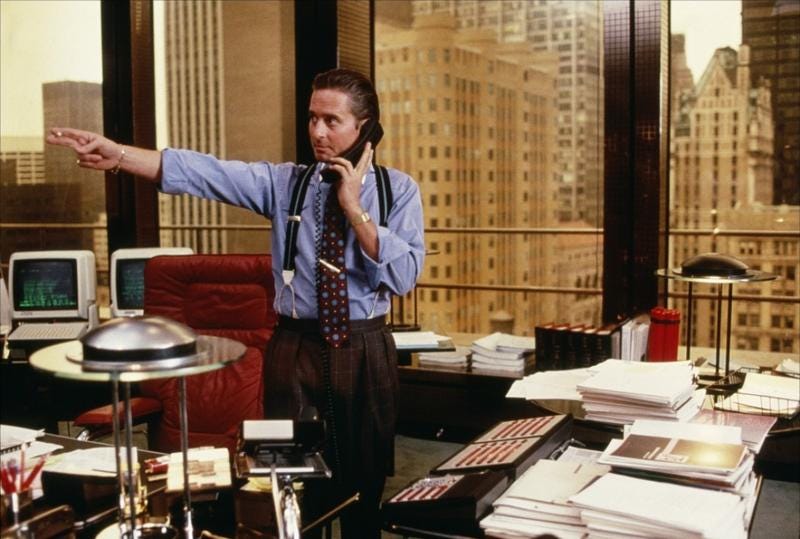
Sixteen years later, in 1987, we get a very different vision of New York in Wall Street. The physical spaces alone tell the story: the brokerage floors in Manhattan - glass, chrome, screens - are set against the blue-collar airline maintenance hangars in Queens, where Bud Fox’s father works amid tools, rust, and sweat. The geography maps two moral philosophies. Lou Mannheim’s older capitalism imagines finance as support for productive industry: money enabling work. Gordon Gekko’s doctrine is the opposite. “I create nothing; I own,” he says, the line a statement of the new economic reality, in which value is conjured through information. Not labour.
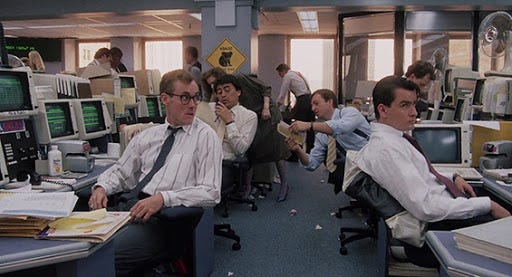
For Gekko, capitalism has shed its material body. In The French Connection, the chase is for drugs, cash, cars, couriers. In Wall Street, the chase is for information: price movements, takeover rumours, insider tips. The substance is gone; only the signal remains. Bud sneaking around corporate offices, or trying to charm receptionists to reach the people above him, becomes the film’s version of the street-level pursuit from Friedkin’s world. The barriers have changed form: doormen, maître d’s, phone systems, social capital. The city’s verticality becomes a map of access; knowledge flows upward, and those above profit first. In Gekko’s universe, whoever controls the stream of information controls the mechanism of transformation: the ability to turn knowledge into wealth faster than anyone else can react.
Stone underscores this shift through the film’s aesthetics. The brokerage office is an aquarium: transparent, brightly lit, everything seemingly on display, yet nothing truly visible. The information on the screens appears open but is deeply coded; the transparency conceals power rather than revealing it. Gekko’s art collection works the same way. The paintings and sculptures have value because of the stories attached to them—provenance, scarcity, the aura of ownership. What matters is not the object itself but the narrative that justifies its price. Darien, who works as an interior decorator, performs the same symbolic function. Her job is to script spaces: to arrange objects so they tell a story about status, success, refinement. In both cases, capital is shown as narrative alchemy, turning perception into price. Transformation becomes the film’s moral vocabulary; business is all about shedding, gutting unions, cutting costs, removing obstacles to profit. It sounds cleansing, almost evolutionary, until you realise those “obstacles” are real people whose lives are being written out of the story.
Wall Street thus presents two forms of capitalism: one grounded in production, patience, and the slow grind of fundamentals; the other based on speed, secrecy, and the alchemy of information. The film’s sympathies clearly lie with Mannheim’s world—the ethic of work, the dignity of craft, the belief that finance exists to support industry. But its head knows better. The power lies with Gekko: the new capitalism of access, asymmetry, and instantaneous transformation. Stone’s film mourns the passing of the older form even as it recognises that only the new one now dominates New York – and hence the world.
Access No Areas
Like many Kubrick films, Eyes Wide Shut was released to mixed, rather baffled reviews (in 1999, the last film he completed), but has grown in stature since. Perhaps its marketing as an “erotic thriller” and the prurient hopes greeting the casting of real-life couple Tom Cruise and Nicole Kidman meant it could not hope to satisfy the imaginations of those seeing it for the first time. (Which might rather be one of its key points). David Edelstein of Slate for example dismissed it as “estranged from any period I recognize… Who are these aristocrats whose limos take them to secret masked orgies in Long Island mansions? Even dream plays need some grounding in the real world.”
Regardless, Eyes Wide Shut did seem rather odd on first viewing. Tom Cruise’s character Bill Harford wanders through corridors, discovers a bizarre masked plutocratic ritual orgy, gets kicked out, then retraces his steps until he is warned off, then goes home. Plotwise, there’s really not much more to it. At the time, secret sex parties for the wealthy perhaps seemed rather absurd: a figment of feverish conspiracy theories for the tinfoil-hat crowd. Now we know better. Places like Jeffrey Epstein’s island do exist; men as powerful as the secretary of the Treasury or the president of Harvard (perhaps even the president of the United States) do trade sexual favours; young women are traded like cattle. There is a conspiracy of silence. Perhaps Edelstein knows better now.
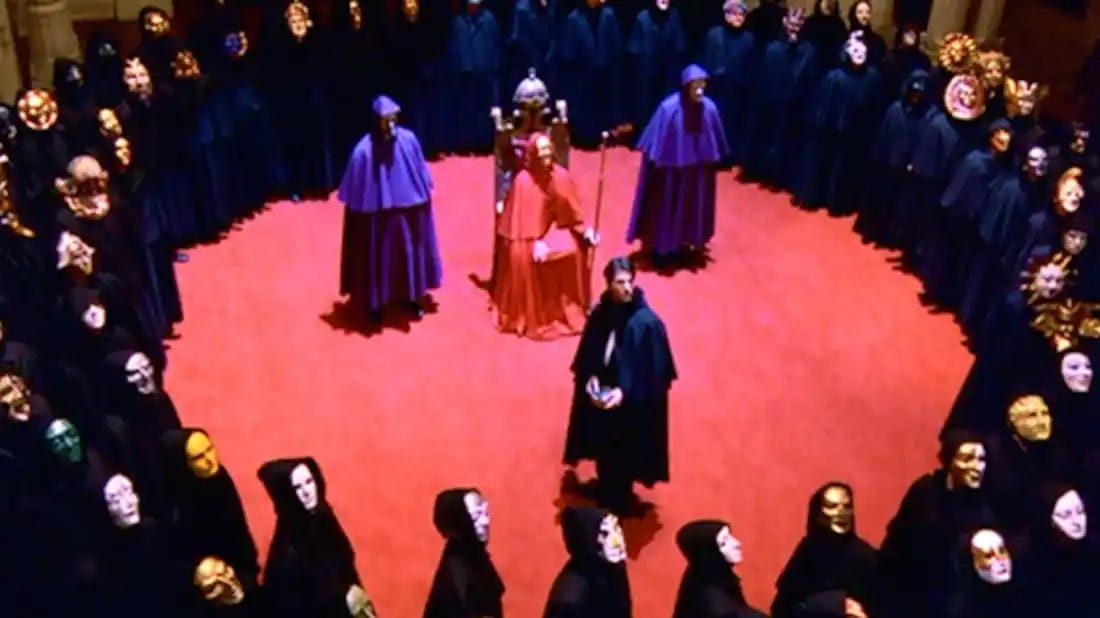
Realising this, I rewatched Eyes Wide Shut recently and it made enormous sense as an analysis of a diseased modern capitalism that goes far beyond Gordon Gekko’s summation. Here, wealth is not earned or even summoned, but a state of being. Money no longer moves, it presides. We move from the open circuits of The French Connection to the gatekept access points of Wall Street to where brownstones, limousines, and mansions are temples for the elect only.
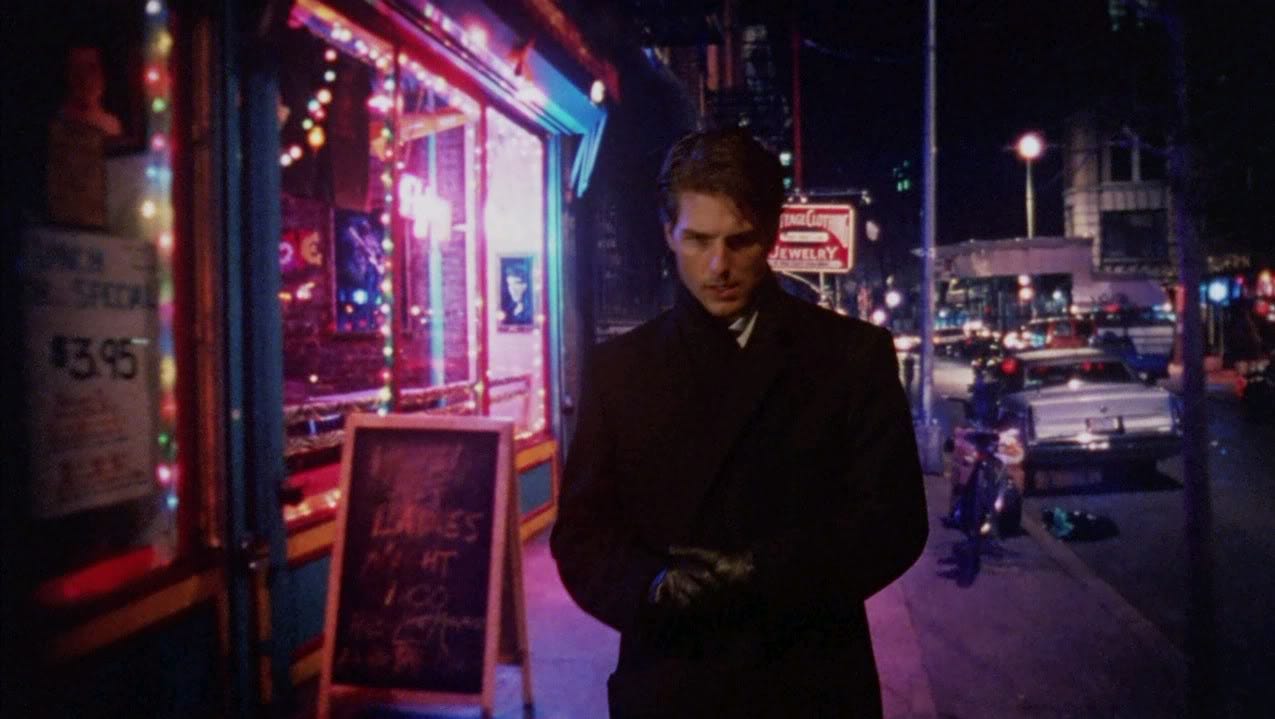
What strikes you immediately in Kubrick’s direction is the glow. New York in Eyes Wide Shut is saturated with coloured lights - shop windows, Christmas trees, streetlamps, the fluorescence of night-time commerce. The whole city gleams as if a permanent display case, a neon Chinatown of desire. It’s the visual grammar of retail: illumination as persuasion. Christmas becomes capitalism’s halo. The lights promise warmth, community, festivity, yet everything they illuminate is transactional.
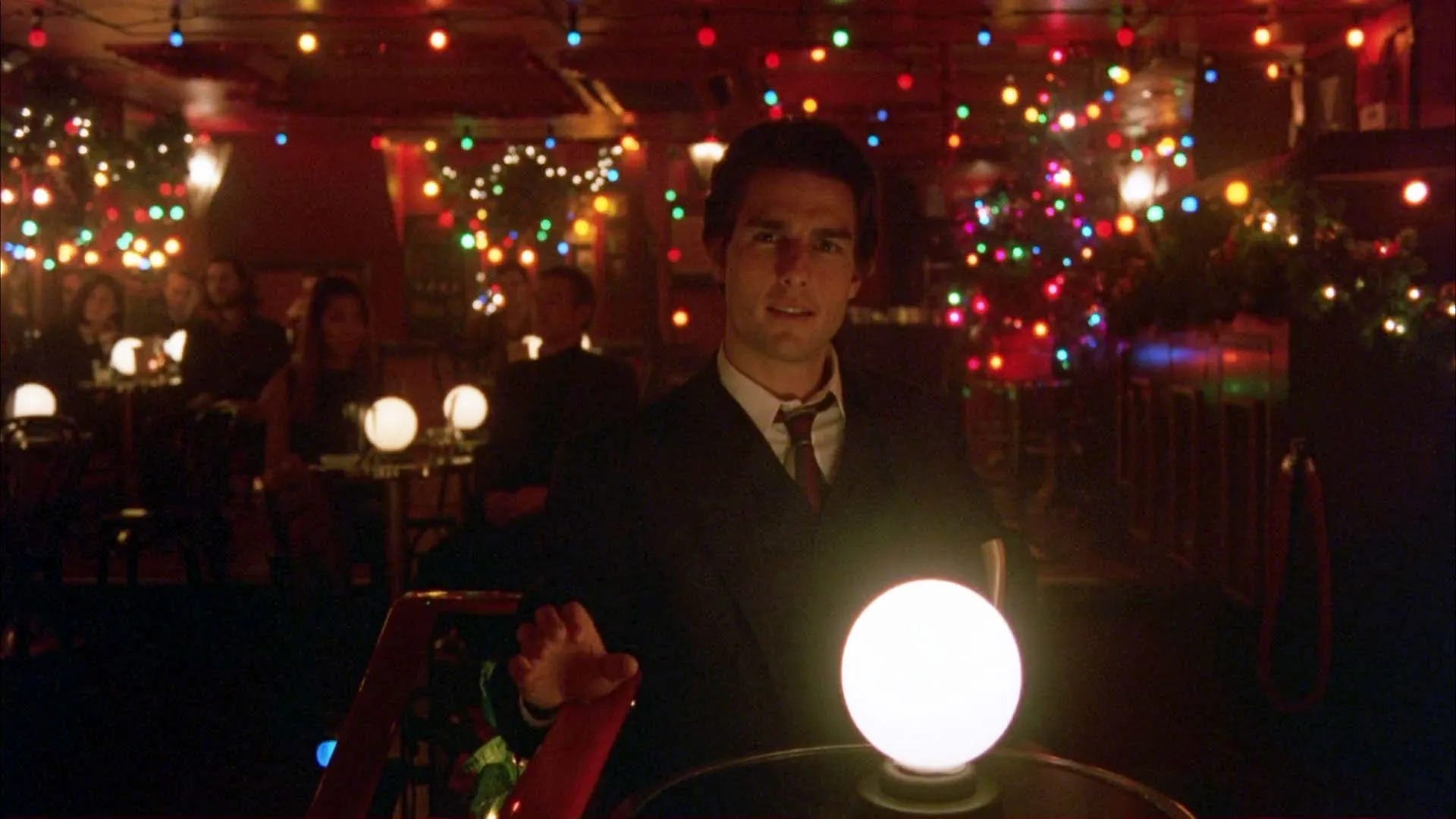
Within this hyper-illuminated city, Kubrick fills the film with corridors. Bill Harford spends most of the narrative walking down hallways, passing through lobbies and stairwells that lead to nothing. These liminal spaces are not simply transitional; they are the architecture of an elite. The hidden world is always one door further on, one password deeper in. Corridor after corridor imitates the structure of capital, and of power (where the two intertwine): you can advance endlessly, but never arrive. Harford, arrogantly assured of his professional proximity to wealth, assumes he belongs. Yet the film shows him perpetually on the threshold: admitted far enough to feel special, but never far enough to see the mechanism.
Even his name is transactional. “Bill” sounds like paperwork, receipts, ledger entries — the small bureaucratic debris of commerce. Kubrick never underlines this, but the echo is unmistakable: Harford is a man whose identity is linked to payment. He is the professional class personified: comfortable within the system, prosperous because of it, but utterly dependent on the wealthy whose lives he services. Only his friendship with Victor (another symbolic name) saves him. But Victor, secure in his mansion and toying with Bill as with the snooker balls in his games room, knows he can destroy this man if he chooses. Is he lying about what happened to Mandy and Nick? Perhaps. But Bill will never know. He does not have the access. He signs death certificates, but he does not have the means to cause them.
Even Bill’s gloves matter. Harford wears them constantly at night: black leather, immaculate, professional. They’re not just protection but insulation. Just as Gekko never dirties his hands with labour, Harford avoids the texture of the city he wanders through. He can look but can’t touch. In a film obsessed with surfaces, the gloves become a small but telling symbol of his condition, as a man who handles everything, but can touch nothing.
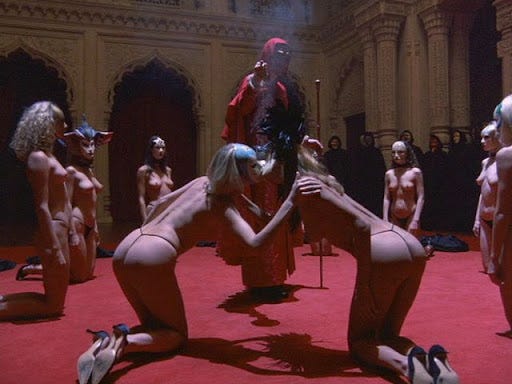
Where Wall Street had access points, Eyes Wide Shut has masks and passwords. In the orgy, these operate as instruments of class segregation. They are metaphorical financial mechanisms, symbolic blockchain codes. The guests are anonymous because their identities are irrelevant; their wealth is the only credential that matters. Harford, by contrast, must name himself, explain himself, and ultimately abase himself. His humiliation is the film’s central economic point: the ordinary man can serve the dream, but he cannot inhabit it. The security guards who expel him do so with the same blank professionalism that the maître d’s in Wall Street use to block Bud Fox, except that for Kubrick the stakes are metaphysical. It is the nightmare of being close enough to see the feast, but never permitted to sit at the table. This is envy and jealousy at their most cutting.
This is where the film’s uncanny power lies. Kubrick imagines a form of capitalism in which value has become narrative, sustained through belief, ritual, and secrecy. The wealthy remain so not through labour or even through the manipulation of information, but through the construction of a closed symbolic order in which their pleasures, transgressions, and sins circulate without consequence. The ritual orgy is grotesque not because of the sex but because of the humane vacuum at its centre. It is entirely unerotic, drained of human impulse. Kubrick has always filmed sex as a structure of power rather than as erotica, whether in the delusions Humbert spins around his paedophilic desire in Lolita or the militarised commodification of Vietnamese women in Full Metal Jacket. In Eyes Wide Shut, that logic has been ritualised: desire replaced by hierarchy, naked female bodies as symbols of power, and everything staged to protect the participants from reality.
In this way, Eyes Wide Shut is the logical endpoint of the trajectory that begins with Friedkin’s heroin deals and Stone’s insider trading. Capital has shed its body entirely. It exists now as pure exemption. In this universe, the sexual underworld isn’t distinct from the financial one. It is its ritual expression. Wealth and power have been untethered from every moral hindrance. The rich move unseen through the city, leaving no trace; the rest of us stumble in their wake, oblivious to the architecture built specifically to lock us out.
If Wall Street shows capital becoming information, Eyes Wide Shut shows what comes after information: myth. Meme stocks, crypto surges, NFTs, and the general delirium of online markets reveal an economy driven by collective performance, where all that matters is momentum, not fundamentals. GameStop and Dogecoin were not investments but spectacles of belief where price became a meme. In this world, narrative is not a way of assigning value, as with Gekko’s art collection; it is the value itself. If “influencers” now create narrative, they are digital labourers, micro-serfs. The asymmetry remains. The wealthy control the platforms, the liquidity, the exit points. This is capitalism’s true mask: bread and circuses on the outside, rigid hierarchy underneath.
Eyes Wide Shut is thus a film about the end of a city as a shared civic space. It predicts the world in which we now live, where access to power is so segmented as to be feudal. What was once an open marketplace (The French Connection) becomes a series of guarded portals (Wall Street), and finally a set of sealed chambers accessible only to the chosen. Bill will never know the second password. His arrival at the mansion in a taxi means he was marked as substandard from the start. What remains is not production or even circulation but preservation: a class that protects itself from consequence by withdrawing from visibility altogether. Accountability is pushed downwards, onto workers, fall guys, and functionaries, while exemption rises to the top. The heroin dealers risk arrest; the insider traders risk indictment; men in masks risk nothing at all.
What all three films capture is the rage of watching power from the outside, the sense that the world is organised around doors through which you will never pass. The French Connection shows the desperation of those distrusted by the system; Wall Street the seduction of the would-be billionaires; Eyes Wide Shut the calm contempt of those who live entirely above. That hierarchy is not abstract to us. We feel it. And that is why these films still touch a nerve. They describe a world in which we are always one password short.
Seen together, these three films chart capital’s escape from accountability. Friedkin shows a world where power still touches the ground and can be confronted. Stone presents an order where responsibility is already blurred by speed and information, even as the language of “shareholder value” pretends a higher rationality. Kubrick completes the trajectory by portraying a plutocracy that has slipped the final constraint: the need to answer to anyone outside its own circle. Capitalism, in this most symbolic portrayal, has learned how to put conscience, law, and ordinary human beings on the other side of the door, in order to evade all ethical hindrances. It is the purest power play in modern cinema. That Kubrick saw it so clearly, two decades before its open expression, is astonishing. Today we can recognise that the corruption of wealth is not an aberration but capitalism’s final form.